
Buyers Guide To Sleeping Mats
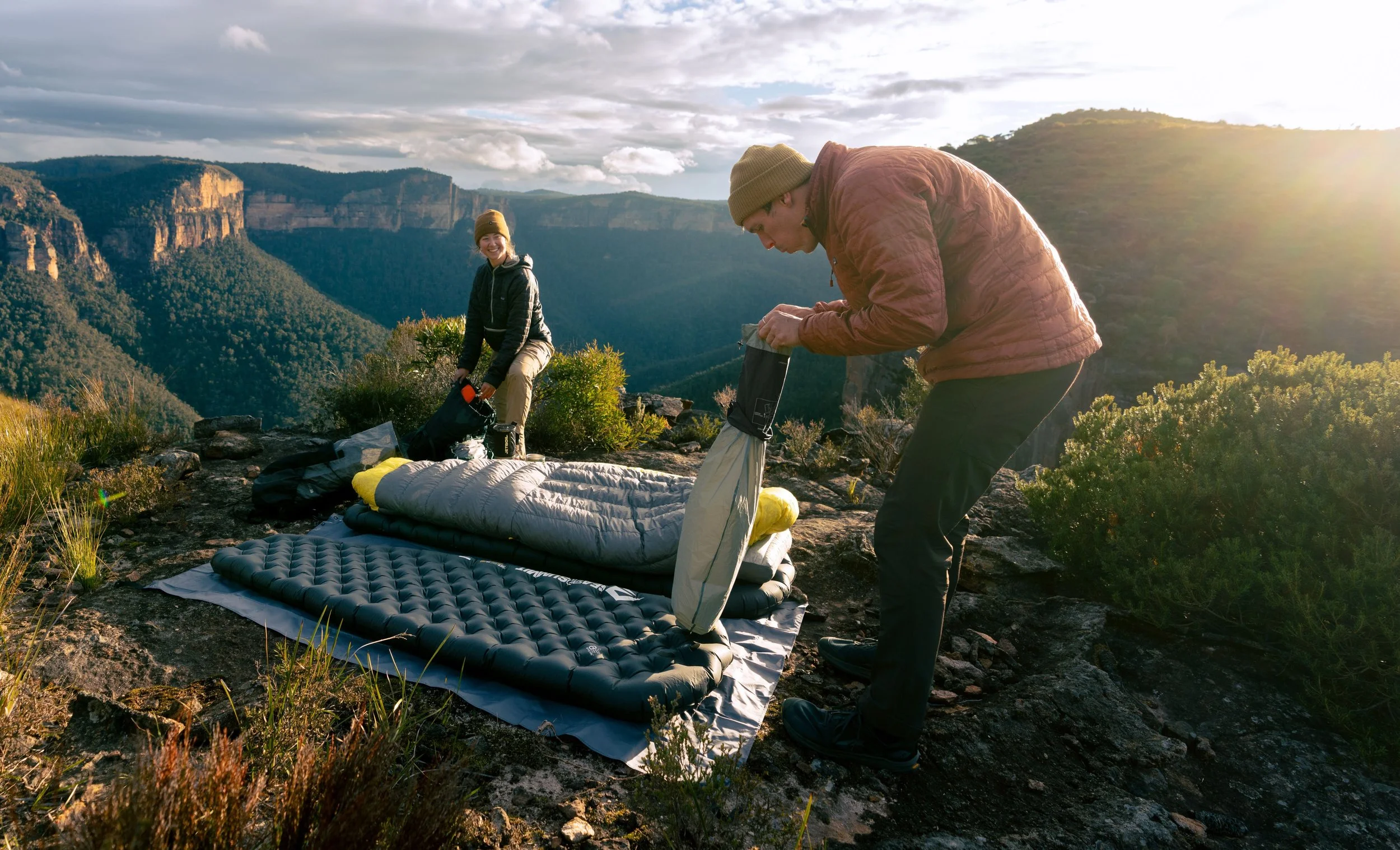
Image: Sea To Summit
Whether you’re bivvying on a small rocky ledge or snug in a tent on a mossy forest floor, sleeping mats provide essential insulation and cushioning from cold hard ground. If you’re not warm enough you’ll struggle to stay asleep and won’t be well rested for your next day’s adventure. Coupled with your sleeping bag, mats work to create a sleeping system you can adapt depending on your needs, but there is a lot to take into consideration……
What are the different types of sleeping mats?
To begin, let’s break down the different types of sleeping mats into three categories:
Inflatable: Lightweight, compact, and the most comfortable. It requires inflation and can puncture.
Self-Inflating: Foam-filled, easy to use, and good insulation. Heavier and bulkier.
Closed-Cell Foam: Incredibly durable, lightweight, and inexpensive. Less comfortable and bulky to pack will have a lower R-Value.
How do I know how warm a mat is going to be?
Happily, since January 2020 there has been an industry standard called the ASTM standard. This is often quoted next to the R-value – a measure of thermal resistance. ‘ASTM F-3340-18’ next to a mat’s R-Value proves it has been tested to a standardized protocol in a laboratory, so you can compare one manufacturer against the other.
In simple terms, the higher the R-Value number the more thermally resistant or “warmer” the mat.
For example: A mat with a rating of 1 – 2.5 is ideal for use in warm climates or if you are using wooden sleeping platforms etc. A mat with a rating of 2.5 – 4 is ideal for use in summer and when there is a possibility of mild ground frost. R-Value 4 – 5.5 would be your go to protection from heavy ground frosts. R-Value 5.5+ will protect you from frozen ground in extreme environments.
A well insulating mat is a key part of your sleep system and could mean you can carry a lighter, less bulky sleeping bag as a result.
Why are there differences between the weight, thickness and pack size of mats showing the same R-Value?
Brainy folk who make sleeping mats discovered you loose heat in two ways through a mat: convective (when warmth from your body is transferred and lost to the ground via air movement inside the mat) and radiant (when body heat transmits through lightweight fabrics and air gaps). The latter can be reduced using metalized or TPU films in the construction that reflect the heat back to you.
Beware; not all metalized films are equal. Cheaper ones can breakdown quickly reducing the R-Value and some are crinkly and noisy. This is a great reason to buy your mat from a shop; so you can test it out while inflated. You can also check it fits…
Take a look at our sleeping mat web page and you will see rectangular, wide, extra wide, long, short and tapered options – a whole array of shapes and thicknesses. This is where fitting can come in handy along with considerations like; are you a back, front or side sleeper to determine the mat width you may need.
A sleeping mats R-Value can be boosted by popping a foam mat underneath. Foam mats are incredibly insulative, but less comfy than a self-inflating or air filled mat.
How do I know how comfy a mat is?
This is very much down to personal choice but once you have narrowed down the R-Value, shape and weight it’s worth checking if the mat is stable when you roll over. Some tube construction mats have slightly raised side tubes to help with this. Most mats are fairly comfortable if you remain static, however, if you feel the mat wobbling beneath you, or if you roll over and the outermost tube squishes flat causing you to roll off of the mat, try a different one.
Another key question to think about is; do you ‘bottom out’ when laying on the mat? If your hip or shoulder, or both are touching or close to touching the ground it can be uncomfortable, and could possibly result in heat loss. Check the inflation and/or try a different construction method to compare.
My mat says it comes with a pump but all I can’t see one included?
Some styles of mats are self-inflating but others require inflating by hand via a hand pump bag. These have various brand names including: Dry Pump Sac and our personal favourite; Schnozzel.
Designed to fit into the valve, these easy to use sacs roll flat into the mat for storage. Simply attach, hold the end open and allow air to enter, gather the top together, roll and squeeze the trapped air into the mat. It’s super-efficient when you are running on empty at the end of a long day, or at altitude and helps protect your mat from the inside against moisture and mildew.
How should I clean and store my mat?
Grease and dirt from body sweat, mud and spillages can all lead to early degradation of your sleeping mat. So, like all great kit, you can prolong it’s life (and your investment) by taking care of it. Use mild soap and warm water to wipe down your mat, rinse thoroughly and allow it to air dry completely before storing. For deep cleaning, a soft brush can help remove dirt from textured surfaces. Once thoroughly dried, check all valves and ensure they are also clean and in working order.
Proper storage helps preserve your mat’s insulation and prolongs its lifespan. Where possible store your self-inflating mat uncompressed, laid flat or upright, keep the valve open to maintain foam integrity, as this will help to prevent the build-up of mildew etc damaging any foam or insulating fillings inside. If necessary, air-filled mattresses (not self-inflating foam types) can be stored tightly rolled in their stuff-sack or ideally, unrolled and partially inflated in a cool, dry place.
How do I repair my mat?
We hold a wide range of spares in stock including patches, some valves, tapes and glues. Many mats come with their own sets for emergencies but if you are heading somewhere off the beaten track then be sure to stock up on extras.
You Tube is a great place to check out the different brands advice for mending your mat. You can also find more information on our Joe Brown Outdoor Academy website.
Top Tips:
Women’s specific mats generally come with a higher R-Value to allow for extra heat loss during sleep.
Keep your mat away from sharp object and heat.
Don’t leave your mat fully inflated in a hot tent during the day, ease a little air our when you wake up, or leave deflated.
Some mats include a pillow lock that corresponds with their range of inflatable pillows for the optimum night’s sleep.